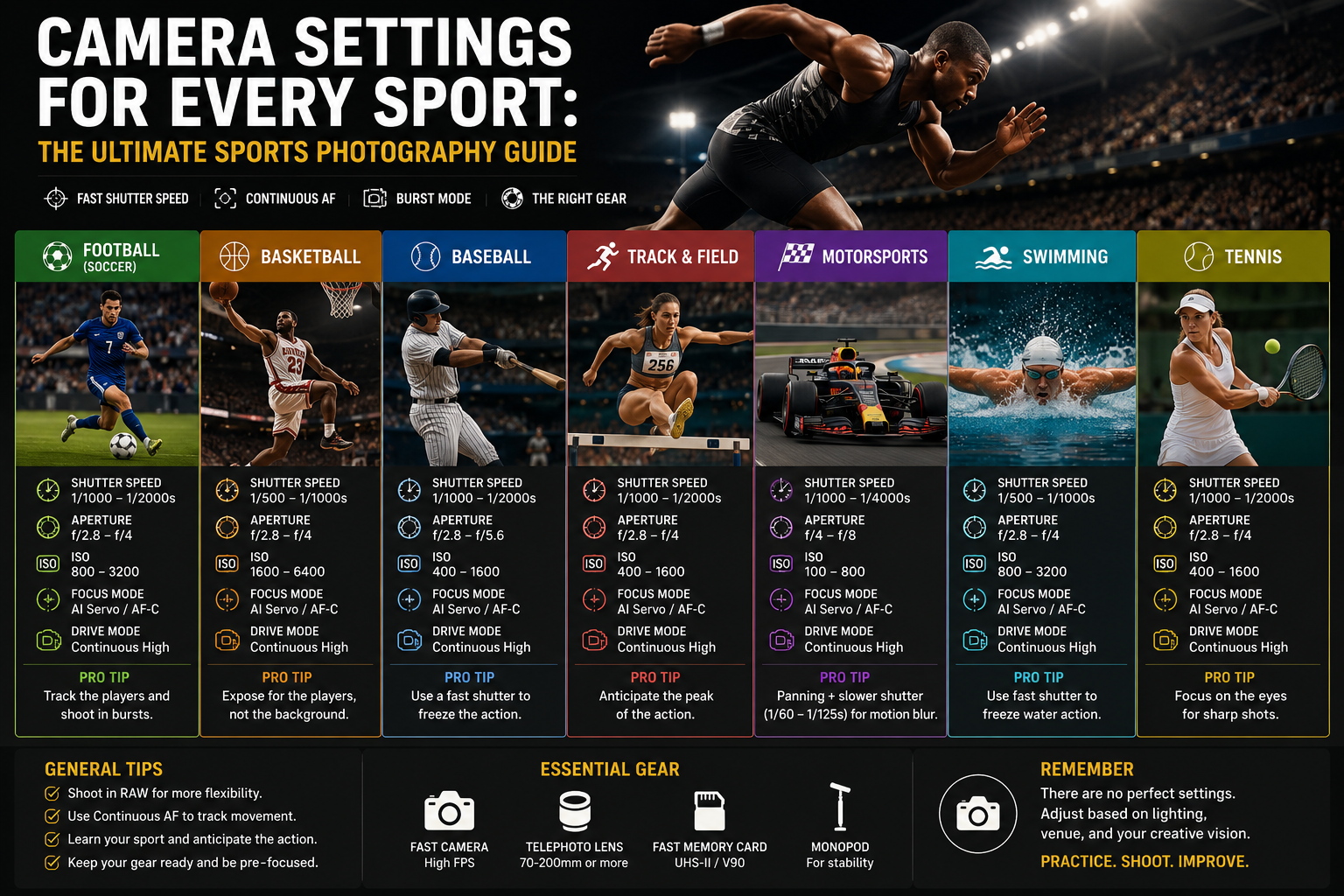
Camera Settings for Every Sport: The Ultimate Sports Photography Guide
By CWP Media
One of the most common questions we hear at CWP Media is:
"What camera settings should I use for sports photography?"
The answer depends on the sport, available light, and your camera, but there are proven settings that consistently produce sharp, professional-looking images.
This guide covers recommended starting points for some of the most popular youth, high school, collegiate, and professional sports.
Understanding the Three Most Important Settings
Before diving into each sport, it's important to understand the three settings that control nearly every sports photograph.
Shutter Speed
Controls how motion is frozen.
1/640 – Slow-moving action
1/800 – General sports
1/1000 – Football, soccer, baseball
1/1600 – Fast action
1/2000+ – Motorsports, hockey, baseball swings
For sports photography, shutter speed should almost always be your top priority.
Aperture
A wide aperture lets in more light while creating a beautifully blurred background.
Ideal settings:
f/2.8
f/3.2
f/4
If your lens isn't that fast, don't worry. Plenty of excellent sports images are made at f/5.6.
ISO
Raise ISO only as much as needed to maintain your desired shutter speed.
Modern cameras handle higher ISO values much better than they did just a few years ago.
Typical ranges:
Sunny Day: ISO 100–400
Cloudy Day: ISO 400–800
Evening Games: ISO 1600–3200
Indoor Sports: ISO 3200–6400 (or higher if necessary)
A little noise is much better than a blurry photograph.
Football
Football combines speed, collisions, and emotion.
Recommended Settings
Mode: Manual or Shutter Priority
Shutter Speed: 1/1250–1/2000
Aperture: f/2.8–f/4
ISO: Auto (set a maximum your camera handles well)
Autofocus: Continuous AF (AI Servo / AF-C)
Drive Mode: High-Speed Continuous
Tips
Watch the quarterback before the snap.
Follow receivers instead of the football.
Stay ready for celebrations after touchdowns.
Soccer
Soccer requires constant tracking across a large field.
Recommended Settings
Shutter Speed: 1/1250
Aperture: f/2.8–f/4
ISO: Auto
Autofocus: Subject Tracking
Burst Mode: High
Tips
Don't chase the ball.
Instead, watch developing plays and anticipate where the pass is going.
Baseball & Softball
Timing is everything.
Recommended Settings
Shutter Speed: 1/1600–1/2500
Aperture: f/2.8–f/4
ISO: Auto
Focus Areas
Pitcher's release
Batter's swing
Stolen bases
Diving catches
Dugout celebrations
Basketball
Indoor lighting makes basketball one of the most challenging sports.
Recommended Settings
Shutter Speed: 1/800–1/1000
Aperture: f/2.8
ISO: 3200–6400+
White Balance: Set manually if possible
Tips
Position yourself near the baseline for drives to the basket and reactions after big plays.
Volleyball
The ball moves quickly, but players are relatively stationary during many key moments.
Recommended Settings
Shutter Speed: 1/1000
Aperture: f/2.8
ISO: 3200–6400
Best Moments
Spikes
Blocks
Digs
Team celebrations
Wrestling
Lighting is often inconsistent in gymnasiums.
Recommended Settings
Shutter Speed: 1/800
Aperture: f/2.8
ISO: Auto (up to 6400 or higher)
Tips
Focus on facial expressions and intense moments rather than trying to capture every move.
Track & Field
Many events require different approaches.
Running Events
Shutter Speed: 1/1600
Aperture: f/2.8–f/4
Field Events
Shutter Speed: 1/1000
Focus on:
Long jump takeoff
Pole vault clearance
Shot put release
Javelin throw
Swimming
Indoor pools create difficult lighting conditions and reflective surfaces.
Recommended Settings
Shutter Speed: 1/1000
Aperture: f/2.8
ISO: 3200+
Tips
Capture:
Dive starts
Water splashes
Finishes
Victory celebrations
Cheerleading & Dance
These performances blend athleticism with artistry.
Recommended Settings
Shutter Speed: 1/1000
Aperture: f/2.8
ISO: 3200–6400
Tips
Photograph:
Jumps
Lifts
Tumbling passes
Team formations
Award ceremonies
Motorsports
Fast-moving vehicles require preparation and quick reactions.
Freezing Action
Shutter Speed: 1/2000
Panning
Shutter Speed: 1/125–1/320
Smooth panning creates a sharp vehicle with a motion-blurred background, emphasizing speed.
Rodeo
Rodeo events happen quickly and unpredictably.
Recommended Settings
Shutter Speed: 1/1600
Aperture: f/2.8–f/4
Continuous AF
High-Speed Burst
Focus on:
Bull riding
Barrel racing
Calf roping
Crowd reactions
Tennis
Tennis combines fast lateral movement with explosive serves.
Recommended Settings
Shutter Speed: 1/1600
Aperture: f/2.8–f/4
Continuous AF
Watch for:
Serves
Overhead smashes
Net play
Match-point celebrations
Camera Settings Checklist
Before every game:
✓ Memory cards formatted
✓ Batteries fully charged
✓ Continuous Autofocus enabled
✓ High-Speed Burst mode selected
✓ RAW image format
✓ Auto ISO (or adjusted for lighting)
✓ Lens cleaned
✓ White balance checked
✓ Exposure verified
✓ Time synchronized if shooting with multiple cameras
Pro Tips from CWP Media
Arrive at least 30–45 minutes early to scout the venue and test your settings.
Shoot in RAW to maximize flexibility during editing.
Use back-button focus if your camera supports it.
Follow the athlete's face rather than the ball whenever possible.
Capture the moments before and after the action—celebrations, reactions, and emotions often become the most memorable images.
Review your exposure during breaks, but avoid "chimping" after every shot so you don't miss the next play.
Final Thoughts
There is no single "perfect" camera setting for every sport. Weather, lighting, venue, and equipment all influence your choices. The settings in this guide are excellent starting points that you can fine-tune as your experience grows.
At CWP Media, we believe sports photography is about more than freezing action. It's about preserving the emotion, determination, teamwork, and unforgettable moments that athletes and families will cherish for years to come.
The more you practice, the better you'll become at reading the game, anticipating the action, and creating images that tell the complete story.